Research note: Beyond benchmarks—Quantifying the impact of policy and behavior on space planning with Simulation.
Based on our work with enterprise clients, our research shows how you can optimize space planning and forecasting when you quantify the impact of policy and behavior to drive enterprise planning with simulation.
Introduction
Using benchmark data, we applied the Large organizations plan at scale — yet they operate in constant flux.
Workforce dynamics, technology adoption, and real estate utilization shift faster than static models can capture.
Traditional enterprise forecasting isolates planning, human, and financial data, creating gaps between work policy and the behaviors that shape enterprise resources. The result is reactive decision-making that trails behind the evolving needs of the workplace.
These inefficiencies compound across the system: underused assets, mismatched capacity, suboptimal experiences, and investment decisions made with only partial visibility. To close this gap, Synthetic Studio has developed a quantitative approach to Enterprise Space Planning Analysis — one that models the enterprise as a living system rather than a set of disconnected parts.
The failure of Linear Thinking
For decades, workplace and enterprise space planning have relied on intuition and blunt ratios: one desk per person, fixed density targets, collaboration ratio and areas sized to market averages. The uncertainty is even higher for collaboration and amenities—allocated at a macro level without ability to measure the impact on employee experience.
Our modelling approach shows that traditional planning calculations include a 5 – 45% space buffer per space type at the program level, significantly compounding space inefficiencies at the portfolio level. These traditionally linear assumptions and their standard buffers create structural waste.
Even the most sophisticated enterprise models often rely on linear assumptions — steady-state utilization, fixed sharing ratios, predictable attendance.
Variable
Description
Challenge
Requirements
1:1 seats (no
sharing)
Attendance varies by role and day
Overbuild 10–40% of desks
Size to 95th percentile attendance ÷ sharing cap
Hourly averages
Peaks are much higher than averages
Desk/room shortages on anchor days
Size to 15-min P95 peaks
Bookings = demand
No-shows and constraints distort data
Wrong room mix
Clean bookings + model concurrency
Fixed collab ratios
Calls and small groups substitute
Collab shortfalls at peak
Floors per headcount + concurrency rules
Uniform policy
effect
Role norms/policy strictness vary
Mis-sized peaks
Map policy to team attendance
One sharing ratio
Volatile teams can’t sustain uniform ratios
SLA failures
Cap sharing by archetype; buffer volatility
Introduction
Using benchmark data, we applied the Large organizations plan at scale — yet they operate in constant flux.
Workforce dynamics, technology adoption, and real estate utilization shift faster than static models can capture.
Traditional enterprise forecasting isolates planning, human, and financial data, creating gaps between work policy and the behaviors that shape enterprise resources. The result is reactive decision-making that trails behind the evolving needs of the workplace.
These inefficiencies compound across the system: underused assets, mismatched capacity, suboptimal experiences, and investment decisions made with only partial visibility. To close this gap, Synthetic Studio has developed a quantitative approach to Enterprise Space Planning Analysis — one that models the enterprise as a living system rather than a set of disconnected parts.
The failure of Linear Thinking
For decades, workplace and enterprise space planning have relied on intuition and blunt ratios: one desk per person, fixed density targets, collaboration ratio and areas sized to market averages. The uncertainty is even higher for collaboration and amenities—allocated at a macro level without ability to measure the impact on employee experience.
Our modelling approach shows that traditional planning calculations include a 5 – 45% space buffer per space type at the program level, significantly compounding space inefficiencies at the portfolio level. These traditionally linear assumptions and their standard buffers create structural waste.
Even the most sophisticated enterprise models often rely on linear assumptions — steady-state utilization, fixed sharing ratios, predictable attendance.
Variable
Description
Challenge
Requirements
1:1 seats (no
sharing)
Attendance varies by role and day
Overbuild 10–40% of desks
Size to 95th percentile attendance ÷ sharing cap
Hourly averages
Peaks are much higher than averages
Desk/room shortages on anchor days
Size to 15-min P95 peaks
Bookings = demand
No-shows and constraints distort data
Wrong room mix
Clean bookings + model concurrency
Fixed collab ratios
Calls and small groups substitute
Collab shortfalls at peak
Floors per headcount + concurrency rules
Uniform policy
effect
Role norms/policy strictness vary
Mis-sized peaks
Map policy to team attendance
One sharing ratio
Volatile teams can’t sustain uniform ratios
SLA failures
Cap sharing by archetype; buffer volatility
Introduction
Using benchmark data, we applied the Large organizations plan at scale — yet they operate in constant flux.
Workforce dynamics, technology adoption, and real estate utilization shift faster than static models can capture.
Traditional enterprise forecasting isolates planning, human, and financial data, creating gaps between work policy and the behaviors that shape enterprise resources. The result is reactive decision-making that trails behind the evolving needs of the workplace.
These inefficiencies compound across the system: underused assets, mismatched capacity, suboptimal experiences, and investment decisions made with only partial visibility. To close this gap, Synthetic Studio has developed a quantitative approach to Enterprise Space Planning Analysis — one that models the enterprise as a living system rather than a set of disconnected parts.
The failure of Linear Thinking
For decades, workplace and enterprise space planning have relied on intuition and blunt ratios: one desk per person, fixed density targets, collaboration ratio and areas sized to market averages. The uncertainty is even higher for collaboration and amenities—allocated at a macro level without ability to measure the impact on employee experience.
Our modelling approach shows that traditional planning calculations include a 5 – 45% space buffer per space type at the program level, significantly compounding space inefficiencies at the portfolio level. These traditionally linear assumptions and their standard buffers create structural waste.
Even the most sophisticated enterprise models often rely on linear assumptions — steady-state utilization, fixed sharing ratios, predictable attendance.
Variable
Description
Challenge
Requirements
1:1 seats (no
sharing)
Attendance varies by role and day
Overbuild 10–40% of desks
Size to 95th percentile attendance ÷ sharing cap
Hourly averages
Peaks are much higher than averages
Desk/room shortages on anchor days
Size to 15-min P95 peaks
Bookings = demand
No-shows and constraints distort data
Wrong room mix
Clean bookings + model concurrency
Fixed collab ratios
Calls and small groups substitute
Collab shortfalls at peak
Floors per headcount + concurrency rules
Uniform policy
effect
Role norms/policy strictness vary
Mis-sized peaks
Map policy to team attendance
One sharing ratio
Volatile teams can’t sustain uniform ratios
SLA failures
Cap sharing by archetype; buffer volatility
The Synthetic Approach
Using simulation, we can quantify much more accurate space type demand based on a combination of policy, activity, and design intent. Synthetic Studio creates a series of targeted simulations that model the relationship among human resource planning, the business requirements of different roles, and the space needs of those roles.
By combining these independent factors, we build a comprehensive model that reveals the range of options available for leaders making key decisions.
Our framework unifies four interlocking factors:
Headcount Forecasting: Projecting workforce needs over time
Role Range & Mix: Mapping distribution of roles and workplace requirements
Space Demand per role: Programming logic based on role level activity considerations
Space Type Allocation: Right-sizing and right-mixing space types for business, location, and people
We model thousands of permutations of these factors to reveal the most likely (and most effective) outcomes and their sensitivity to risk.
The resulting forecast model allows leaders to anticipate impact before committing capital, translating uncertainty into strategies that mitigate risk, anticipate outcomes, and proactively make changes aligned with the shift in workplace dynamics over time.
Methodology
Our research draws on empirical workplace and occupancy data gathered through Synthetic’s engagements with large enterprise clients and our expertise in AEC as well as a set of generalized assumptions about different workplace policies influenced by RTO after COVID
Patterns such as attendance variance, collaboration frequency, and role-based seat sharing were modeled as probabilistic inputs based on data from our work.
We generated Thousands of scenarios to identify the most resilient configurations of space that meet demand across multiple policy and utilization futures.
Key findings
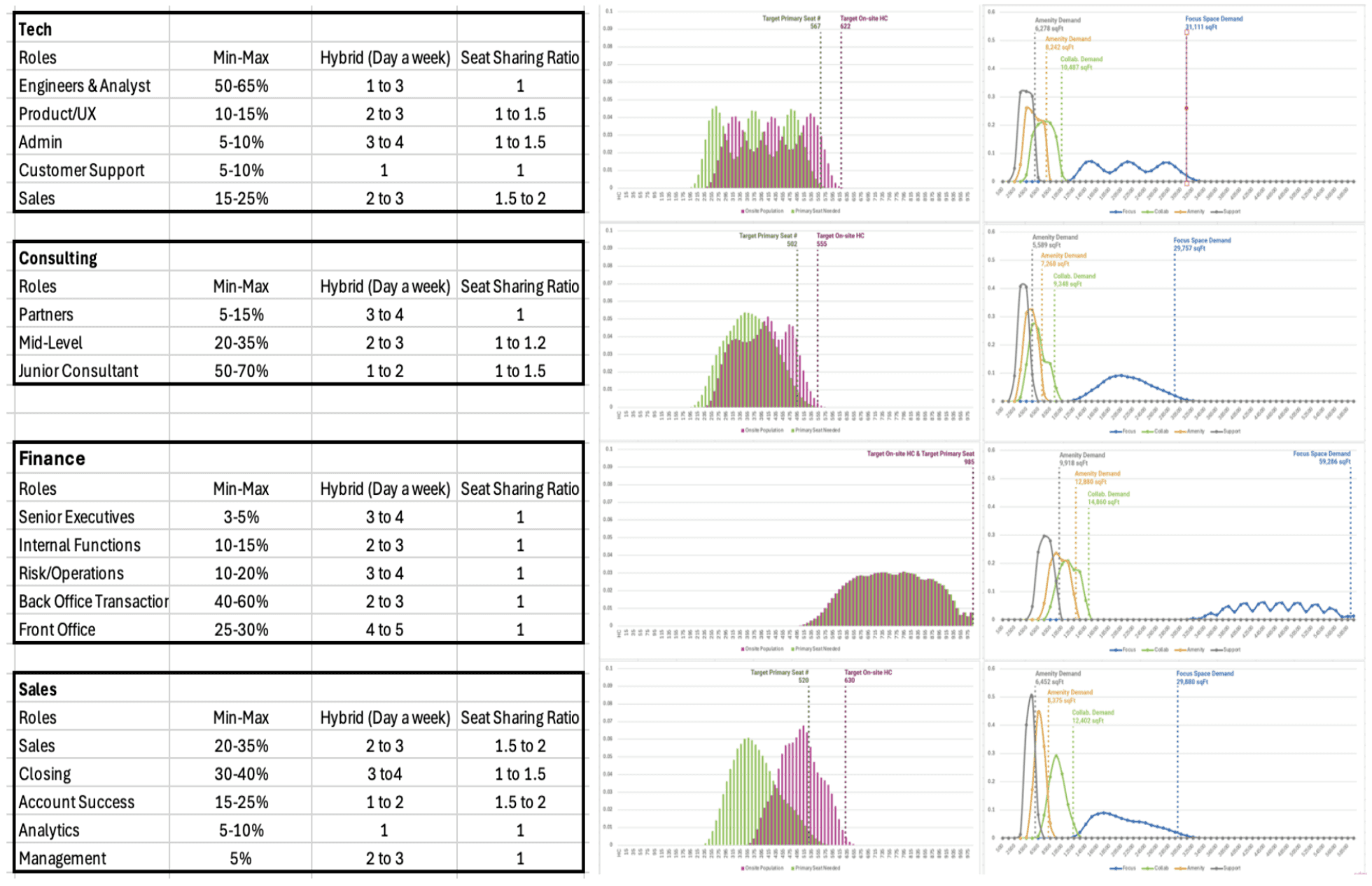
We applied the Synthetic demand modeling approach to four workplace archetypes -----Tech/Creative, Consulting, Legal/Finance, and Sales Office--to test how behavioral variance affects space performance and cost.
Each different workplace archetype was characterized in data by a range of role mixes, likely attendance distributions, and collaboration intensity to generate thousands of demand scenarios per archetype.
Our simulations compared traditional “linear” allocations (based on fixed ratios) with behavioral models that adapt based on policy, team type, and utilization volatility.
The resulting benchmark stress tests showed measurable efficiency gains and cost avoidance across each of the archetypes:
Linear planning assumptions break down when attendance and collaboration fluctuate. Static ratios (e.g., 1:1 seating) systematically overbuild Desks by 5 – 50 %. and under-build conference spaces by 5 – 15%.
Simulation stress testing reveals hidden slack — recovering 5 – 40 % efficiency per space type without compromising experience, more flexible footprints can maintain utilization performance based on anticipated show-up rate and more aggressive seat sharing policies.
Decision coherence improves when financial and spatial models share a behavioral foundation — understanding potential and range of likely outcome of “what-if” analysis across capital and operations.
Implications for enterprise planning
This work illustrates how simulation can serve as a connective tissue between corporate space strategy and execution.
By treating the enterprise as an adaptive system, leaders can:
Forecast workforce and space needs under multiple futures
Quantify risk and opportunity before committing capital
Integrate behavioral evidence into financial planning cycles
Continuously recalibrate investments as conditions evolve
Simulation delivers much higher decision confidence — creating plans that remain valid as behavior changes.
Conclusion
Simulation turns planning from static into a dynamic process. It allows enterprise leaders reduce uncertainty in an era of continuous change. By combining behavioral, spatial, and financial data into one dynamic model, organizations can see their operations as they are and how they are most likely to be in the future— interconnected, adaptive, and measurable.
The resulting benchmark stress tests showed measurable efficiency gains and cost avoidance across each of the archetypes:
Linear planning assumptions break down when attendance and collaboration fluctuate. Static ratios (e.g., 1:1 seating) systematically overbuild Desks by 5 – 50 %. and under-build conference spaces by 5 – 15%.
Simulation stress testing reveals hidden slack — recovering 5 – 40 % efficiency per space type without compromising experience, more flexible footprints can maintain utilization performance based on anticipated show-up rate and more aggressive seat sharing policies.
Decision coherence improves when financial and spatial models share a behavioral foundation — understanding potential and range of likely outcome of “what-if” analysis across capital and operations.
Implications for enterprise planning
This work illustrates how simulation can serve as a connective tissue between corporate space strategy and execution.
By treating the enterprise as an adaptive system, leaders can:
Forecast workforce and space needs under multiple futures
Quantify risk and opportunity before committing capital
Integrate behavioral evidence into financial planning cycles
Continuously recalibrate investments as conditions evolve
Simulation delivers much higher decision confidence — creating plans that remain valid as behavior changes.
Conclusion
Simulation turns planning from static into a dynamic process. It allows enterprise leaders reduce uncertainty in an era of continuous change. By combining behavioral, spatial, and financial data into one dynamic model, organizations can see their operations as they are and how they are most likely to be in the future— interconnected, adaptive, and measurable.