Care delivery was never serial. Patients, providers, families, and support staff have always moved through the same space at the same time, and their choices have always cascaded into one another.
What changed is the time available to learn.
For most of the last few decades, healthcare organizations had enough stability to improve through local trial and error. New staffing models ran for a quarter before teams drew conclusions. A new wing opened, and workflows took a year to settle. Layout mistakes were softened by staff who learned to work around them. Technology changed on a scale of years, not months, and the service lines it supported changed even more slowly.
Optimization was gradual and mostly local, but the operating environment remained consistent enough for the system to find equilibrium over time.
That stability is disappearing.
Throughput expectations are increasing while staff capacity falls. Robots, autonomous logistics, and AI decision support are entering care environments faster than teams can absorb them. Service lines are being redrawn under margin pressure. Workforce compression, new technology, and service redesign are arriving at the same time.
The rate of change has overtaken the rate at which healthcare can learn through live trial and error.
Service pressure and rapid technology development are driving a new wave of healthcare innovation, generating excitement around better patient outcomes and greater service efficiency.
But excitement is not adoption.
Many innovations will succeed or fail on human fit. By the time live operation reveals how a technology performs within actual workflows, spaces, and patterns of behavior, the next wave is already arriving.
Care delivery was never serial. Patients, providers, families, and support staff have always moved through the same space at the same time, and their choices have always cascaded into one another.
What changed is the time available to learn.
For most of the last few decades, healthcare organizations had enough stability to improve through local trial and error. New staffing models ran for a quarter before teams drew conclusions. A new wing opened, and workflows took a year to settle. Layout mistakes were softened by staff who learned to work around them. Technology changed on a scale of years, not months, and the service lines it supported changed even more slowly.
Optimization was gradual and mostly local, but the operating environment remained consistent enough for the system to find equilibrium over time.
That stability is disappearing.
Throughput expectations are increasing while staff capacity falls. Robots, autonomous logistics, and AI decision support are entering care environments faster than teams can absorb them. Service lines are being redrawn under margin pressure. Workforce compression, new technology, and service redesign are arriving at the same time.
The rate of change has overtaken the rate at which healthcare can learn through live trial and error.
Service pressure and rapid technology development are driving a new wave of healthcare innovation, generating excitement around better patient outcomes and greater service efficiency.
But excitement is not adoption.
Many innovations will succeed or fail on human fit. By the time live operation reveals how a technology performs within actual workflows, spaces, and patterns of behavior, the next wave is already arriving.
Care delivery was never serial. Patients, providers, families, and support staff have always moved through the same space at the same time, and their choices have always cascaded into one another.
What changed is the time available to learn.
For most of the last few decades, healthcare organizations had enough stability to improve through local trial and error. New staffing models ran for a quarter before teams drew conclusions. A new wing opened, and workflows took a year to settle. Layout mistakes were softened by staff who learned to work around them. Technology changed on a scale of years, not months, and the service lines it supported changed even more slowly.
Optimization was gradual and mostly local, but the operating environment remained consistent enough for the system to find equilibrium over time.
That stability is disappearing.
Throughput expectations are increasing while staff capacity falls. Robots, autonomous logistics, and AI decision support are entering care environments faster than teams can absorb them. Service lines are being redrawn under margin pressure. Workforce compression, new technology, and service redesign are arriving at the same time.
The rate of change has overtaken the rate at which healthcare can learn through live trial and error.
Service pressure and rapid technology development are driving a new wave of healthcare innovation, generating excitement around better patient outcomes and greater service efficiency.
But excitement is not adoption.
Many innovations will succeed or fail on human fit. By the time live operation reveals how a technology performs within actual workflows, spaces, and patterns of behavior, the next wave is already arriving.
Healthcare is already responding
Health systems recognize the pressure. They are investing in physical simulation facilities to rehearse workflows before deployment. Capacity command centers are creating system-wide visibility from operational data, making cross-unit patterns easier to recognize. Patient experience is increasingly treated as a key measure of care delivery success, with active efforts to link it to operational and financial performance. That strengthens the case for design and operational investment.
Virtual simulation extends these efforts.
A physical simulation facility rehearses a specific workflow with a limited number of participants. Virtual simulation can test many workflows across environments that do not yet exist.
A command center reveals the patterns in what has already happened. Simulation carries those patterns forward into configurations the system has not run yet, where there is no history to read. The data a system has already collected helps ground the futures it is weighing.
A pilot can show whether a technology works under selected conditions. Simulation can test how it performs across thousands of combinations of layout, staffing, demand, and behavioral response before capital is committed.
Healthcare has always been a discipline where experiments and data guide decisions. Simulation fits that culture. It compresses the rehearsal, tests interactions across the whole environment, and provides quantified evidence about how a proposed decision performs under the conditions tested.
That is what ServiceMatrix does.
Cognitive agents, calibrated to the operating environment, move through the space together. Patients, providers, families, and support staff each act on their own goals and constraints.
Patterns that would have taken quarters to surface in live operation become visible across a series of simulation runs.
Three cases
Robot modality testing.
A component view compares robot specs: which platform moves faster, carries more, or costs less to service. An ecosystem view asks whether the robot produces a net benefit in the environment where it will work.
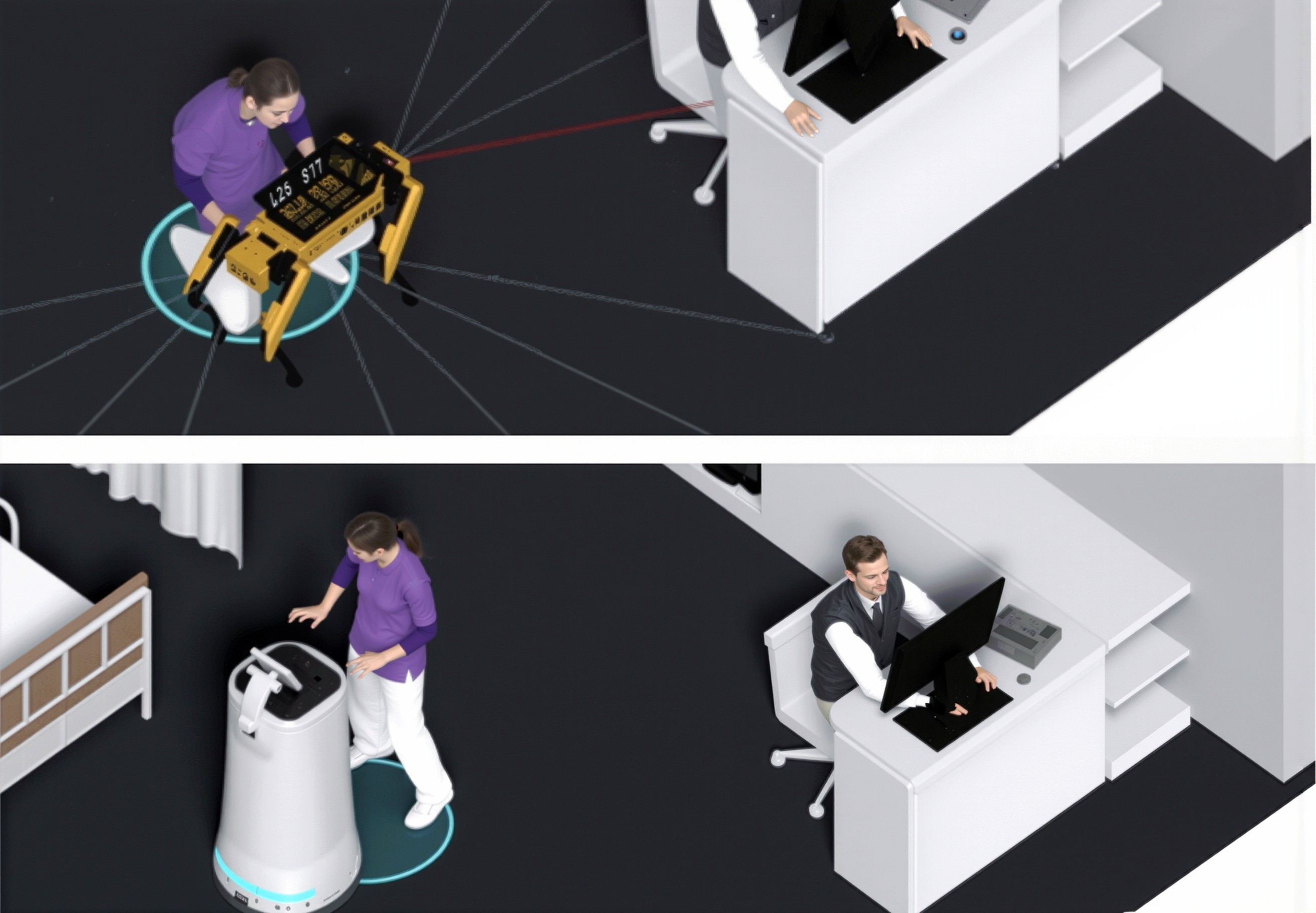
The platform that ranks first on payload and speed may be the one that yields, reroutes, or stalls in corridors it shares with patients, families, staff, and mobile equipment. The slower platform that staff can anticipate may move more work in a day.
Specs don't decide adoption. The ecosystem does.
Social impact on layout strategy.
A component view treats a waiting area as square footage and seating capacity. An ecosystem view examines how families cluster, how patients seek or avoid proximity, and how staff sightlines change as the room fills.
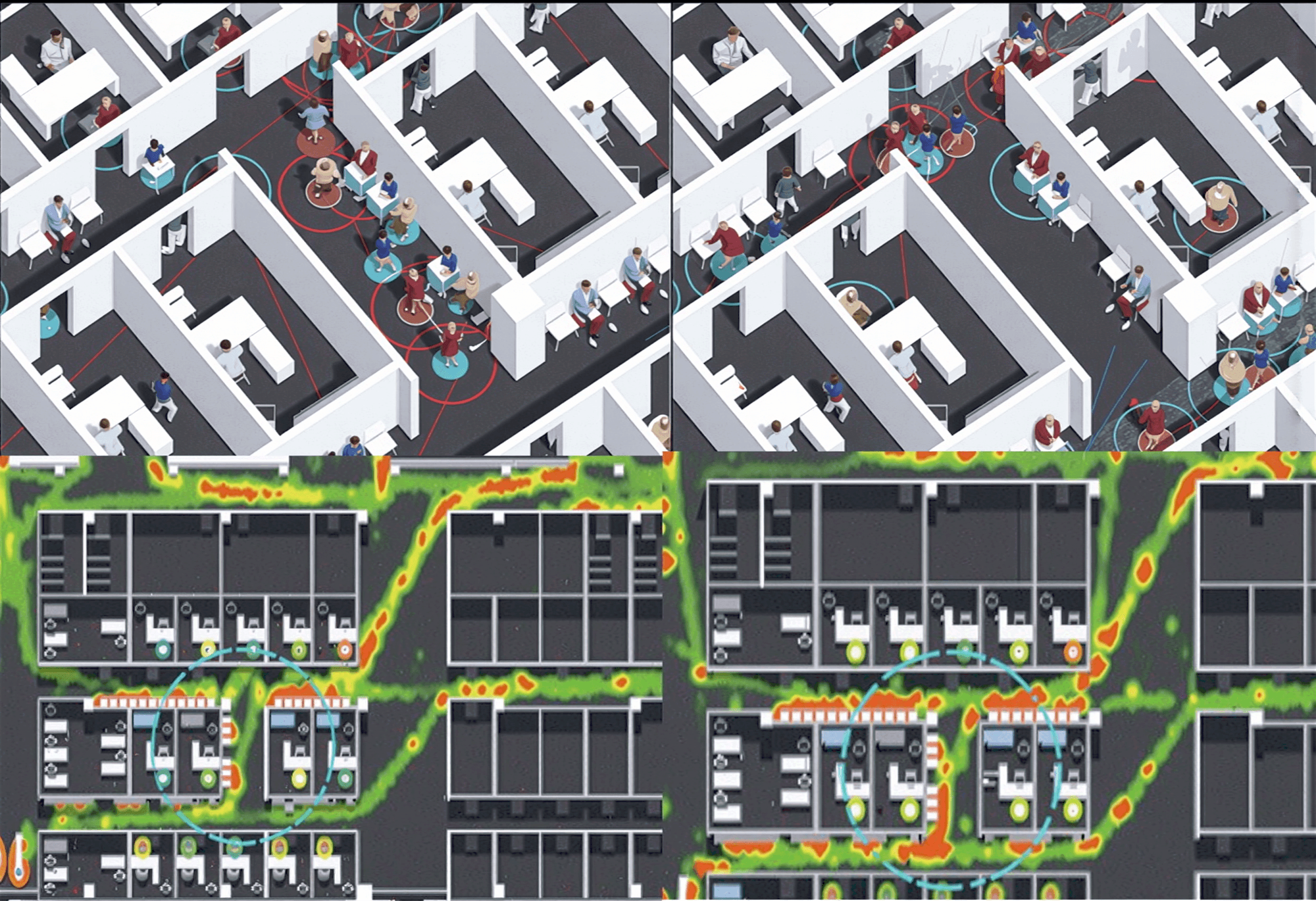
Adjacencies that appear effective on a plan are reshaped by social behavior the moment the space is occupied. Modeling that behavior across layout options reveals which plans remain functional under real occupancy and which quietly fail, producing crowded hallways beside empty waiting rooms.
The people in the room decide, and they decide together.
Layout optimization for robot services.
A component view sizes corridors for the robot by rule of thumb. An ecosystem view determines what each corridor must accommodate in its specific location: the robot, the staff who will pass it, the patients who will encounter it, and the equipment that will queue behind it.
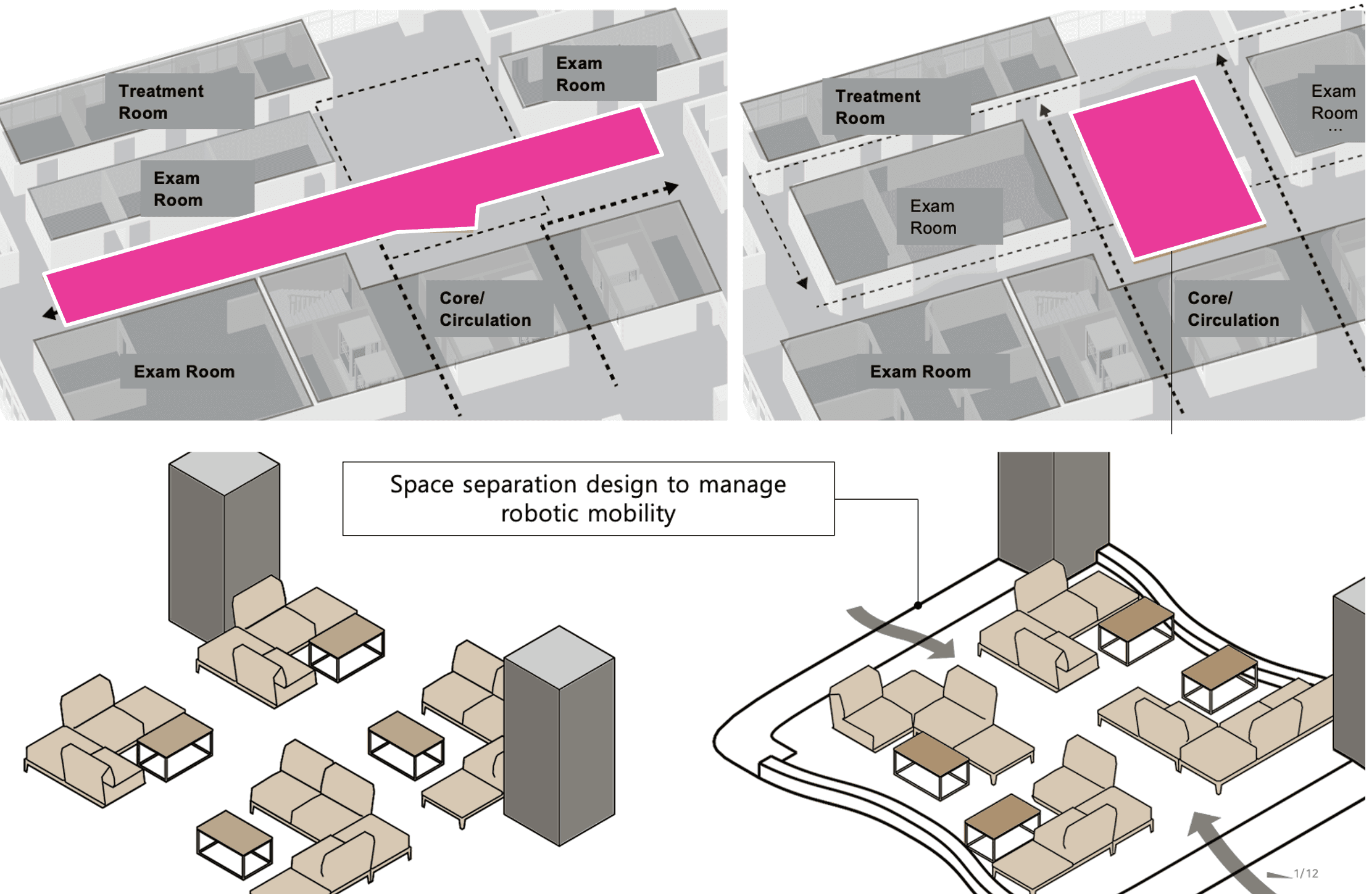
Robot service performance is a spatial decision with downstream effects on every human path in the environment.
Getting the robot's route right and getting the room right are the same problem.
Deliberate adopters
Every wave of healthcare innovation splits organizations in two. Some deploy, encounter friction, and retreat. Others learn how the technology, workflow, workforce, and environment must change together. They adapt faster and build an operating advantage that can take the rest of the market years to close.
Simulation accelerates that learning. A design team sees the bottleneck before the wing is built. An operations team sees the workaround before the robot is deployed. A capital planning team sees which of two adjacencies holds up under real occupancy, not which one scored higher on a static checklist.
For healthcare leaders being asked to absorb new technology, respond to staffing pressure, and hold quality steady all at once, that compression is the point. Trial and error alone is no longer enough.
Simulating the ecosystem is not about predicting what will happen. It is about seeing enough futures before committing to the one you build.
Chang-Yeon Cho, Seung Wan Hong

